

What Exactly Are Chiggers?
Chiggers are the larval stage of mites in the family Trombiculidae, commonly called harvest mites or red bugs. Despite widespread confusion, chiggers are not insects—they are arachnids, closely related to ticks and spiders. Only the larval stage feeds on humans and animals. The nymphs and adults are free-living predators that eat insect eggs and small arthropods in the soil.
Across Texas, Oklahoma, Louisiana, and Mississippi, the most common species is Eutrombicula alfreddugesi, the North American chigger. These tiny mites measure just 0.15 to 0.3 millimeters as larvae—barely visible to the naked eye and often overlooked until their bites begin to itch hours later.
The Complete Chigger Lifecycle: Four Stages
Chiggers undergo incomplete metamorphosis through four distinct stages. Understanding each stage reveals when and where they are most vulnerable—and when they pose a threat to your family.
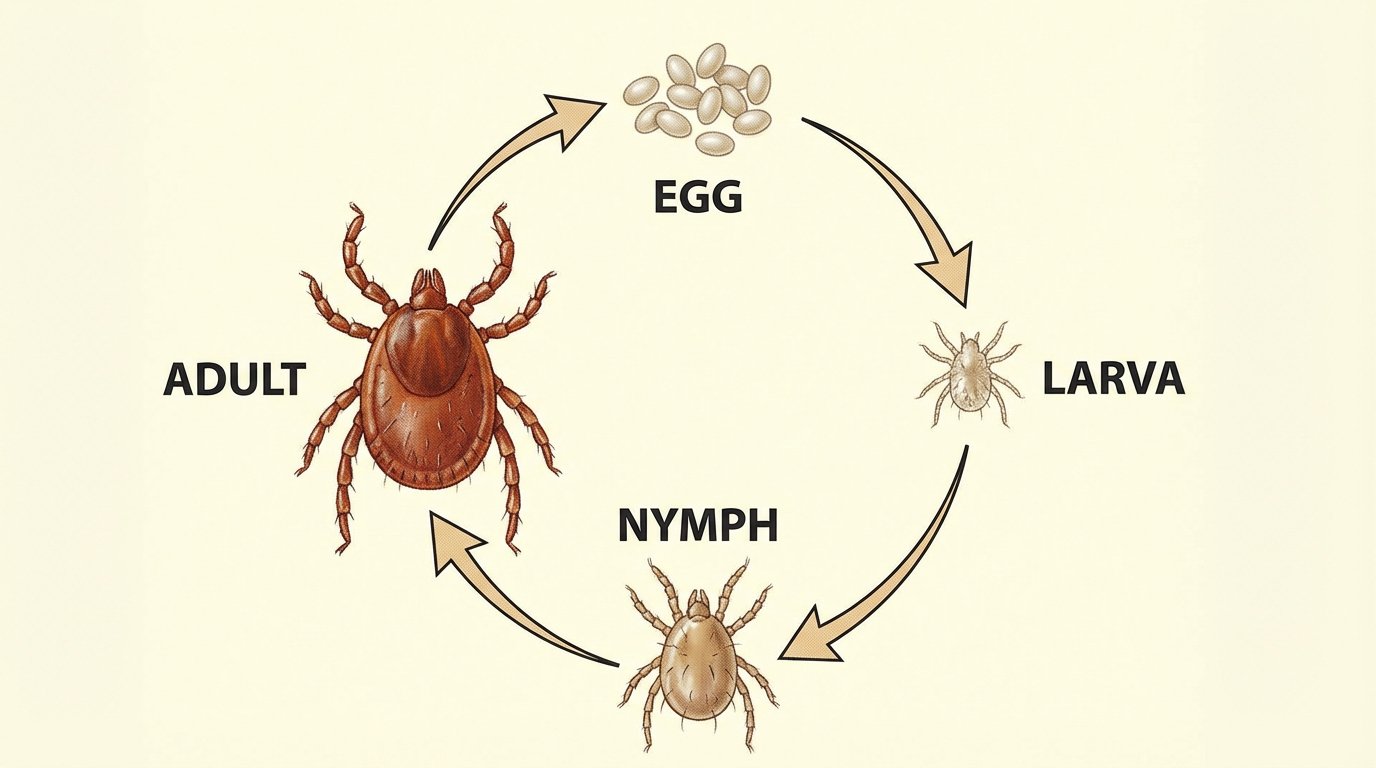
Stage 1: Egg
Adult female chiggers lay eggs in clusters of 3 to 8 on the soil surface, typically in shaded, moist areas with dense vegetation. A single female can lay up to 15 eggs per day during optimal conditions. Eggs are spherical, about 0.1 mm in diameter, and nearly impossible to see without magnification.
In the Southern states, egg-laying peaks from late April through September when soil temperatures consistently stay above 60°F. Eggs hatch in 5 to 7 days under warm, humid conditions. Dry or cold spells slow development significantly.
Stage 2: Larva (The Biting Stage)
This is the only stage that feeds on vertebrate hosts—including humans, dogs, cats, rodents, birds, reptiles, and amphibians. Newly hatched larvae are bright orange-red, six-legged, and about 0.15–0.3 mm long.
Larvae climb onto low vegetation—grass blades, leaf litter, fallen logs—and wait for a passing host. This behavior is called "questing." They detect hosts through vibrations and carbon dioxide. Once on a host, they migrate to areas where skin is thin or clothing fits tightly: ankles, waistbands, behind the knees, and armpits.
Contrary to popular belief, chigger larvae do not burrow under the skin. They pierce the skin surface and inject proteolytic enzymes that dissolve skin cells, creating a hardened feeding tube called a stylostome. They feed on liquefied tissue—not blood—for 1 to 4 days before dropping off to continue their development in the soil.
Stage 3: Nymph
After feeding, engorged larvae drop to the soil and enter a quiescent stage before molting into eight-legged nymphs. This transition takes 1 to 2 weeks depending on temperature. Nymphs are free-living predators that feed on insect eggs, small soil arthropods, and organic matter. They pose no threat to humans or pets.
The nymphal stage lasts roughly 2 to 4 weeks in warm weather. Nymphs are larger than larvae—about 1 mm—and reddish-brown in color.
Stage 4: Adult
Nymphs molt into adults, which are also eight-legged, free-living, and harmless to humans. Adults are the largest stage at 1 to 2 mm and are bright red or orange. They continue feeding on soil organisms, mating, and laying eggs to restart the cycle.
In the warm climates of Texas and the Gulf states, the full lifecycle from egg to adult takes approximately 50 to 70 days. Multiple overlapping generations can occur from May through September, which explains why chigger populations seem to explode during peak summer months.
| Stage | Size | Legs | Duration | Bites Humans? |
|---|---|---|---|---|
| Egg | 0.1 mm | N/A | 5–7 days | No |
| Larva | 0.15–0.3 mm | 6 | 1–4 days (feeding) | Yes |
| Nymph | ~1 mm | 8 | 2–4 weeks | No |
| Adult | 1–2 mm | 8 | Months to 1 year | No |
Where Chiggers Live and Breed
Chigger habitat preferences directly influence where you are most likely to encounter them. They thrive in areas that are:
- Shaded and moist — tall grass, weed patches, brush piles, forest edges, and creek bottoms
- Undisturbed — areas with thick leaf litter, overgrown vegetation, and dense ground cover
- Warm — soil temperatures between 60°F and 85°F, with surface humidity above 70%
In residential settings across the South, the highest-risk zones include:
- Transition areas between mowed lawn and natural brush or woods
- Garden beds with heavy mulch or ground cover plants
- Shaded areas beneath trees, especially where leaf litter accumulates
- Along fence lines, retaining walls, and property borders
- Near creeks, ponds, or drainage areas with persistent moisture
Chiggers are rarely found on well-maintained, regularly mowed lawns in direct sunlight. They cannot survive prolonged exposure to dry, sunny conditions—which is a key insight for yard management.
Seasonal Activity in the South
Chigger activity follows a predictable seasonal pattern tied to temperature and moisture:
- March–April: Overwintering adults emerge and begin laying eggs as soil warms past 60°F
- May–June: First generation of larvae hatches. Encounters begin increasing, especially after rain
- July–August: Peak activity. Multiple overlapping generations create the highest larval density of the year
- September–October: Activity declines as temperatures drop. Final generation of larvae still active in early fall
- November–February: Adults enter diapause (dormancy) in the soil. No biting activity
In Texas and the Gulf Coast states, chigger season can start as early as late March in unusually warm years and extend into November. Oklahoma and northern Louisiana typically see a shorter window from May through September.
Breaking the Chigger Lifecycle in Your Yard
Effective chigger control targets the conditions that support their lifecycle—especially the egg and larval stages where they are most concentrated and vulnerable:
- Mow frequently: Keep grass at 3 inches or less. Short grass increases sun exposure and reduces humidity at ground level, making the habitat inhospitable for eggs and larvae.
- Remove leaf litter and brush: Eliminate ground-level debris where adults lay eggs and larvae quest for hosts.
- Create sunlit buffer zones: Maintain a 6-foot cleared border between your lawn and wooded or brushy areas.
- Reduce moisture: Fix drainage issues, trim overhanging branches, and thin dense plantings to improve air circulation.
- Targeted perimeter treatments: Professional-grade bifenthrin applications along property borders and transition zones eliminate active larvae and create a residual barrier lasting 60 to 90 days.
Because the entire lifecycle from egg to egg takes 50 to 70 days, consistent treatments on an every-other-month to quarterly schedule effectively disrupt reproduction and reduce populations over successive seasons.
When to Call a Professional
DIY habitat modification goes a long way, but properties with persistent chigger problems—especially those bordering wooded areas, pastures, or creek beds—often need professional-grade treatment to truly break the cycle. Romex Pest Control's chigger treatment program targets high-risk zones with residual insecticides and insect growth regulators that interrupt the lifecycle at multiple stages.
If you are dealing with recurring chigger bites despite maintaining your yard, contact Romex for a free inspection. We serve homes across Texas, Oklahoma, Louisiana, and Mississippi.