
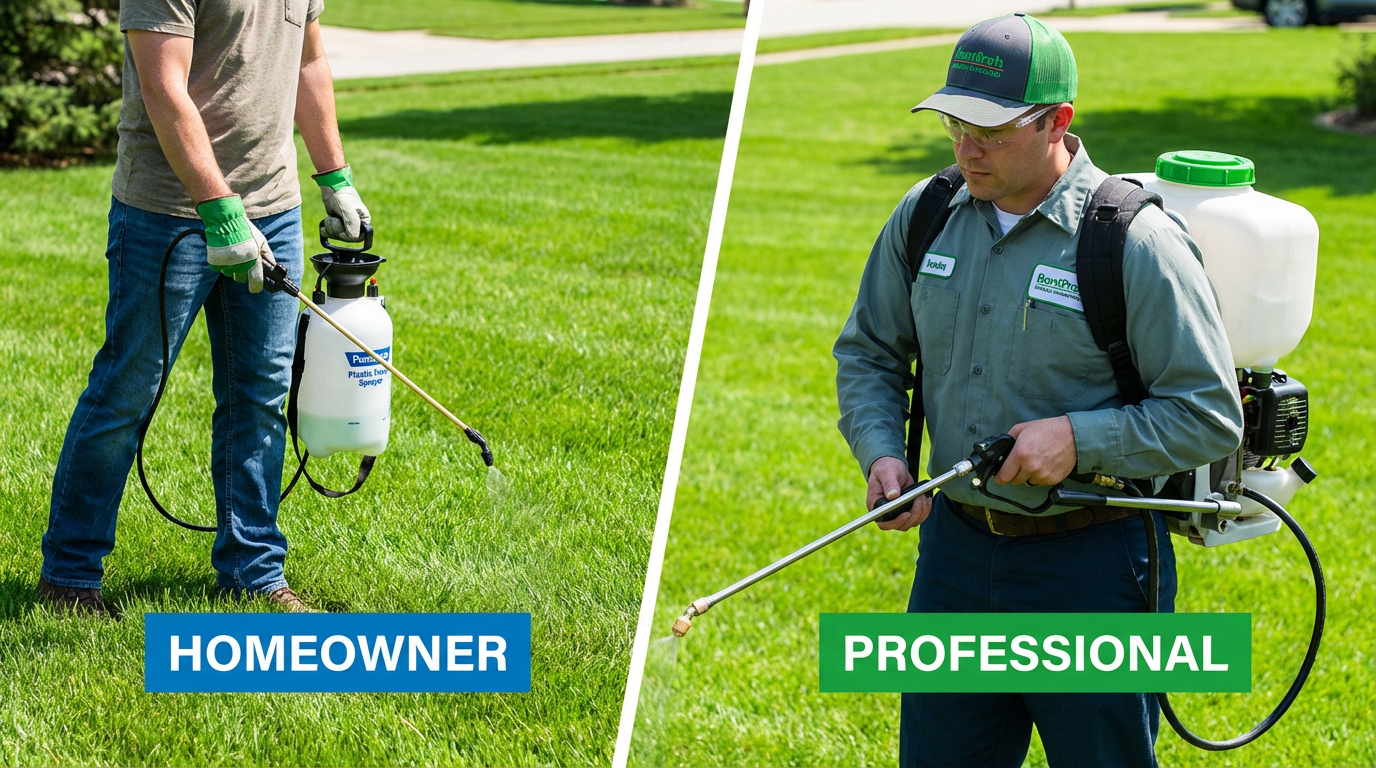
The Chigger Control Decision
When chigger bites start ruining your time outdoors, the first question is usually: "Can I handle this myself, or do I need professional help?" The honest answer depends on three factors: the severity of your problem, the size and layout of your property, and how much time you are willing to invest in ongoing maintenance.
Both DIY and professional approaches have legitimate roles. Here is a straightforward comparison to help you make the right call for your situation.
DIY Chigger Control: What You Can Do Yourself
DIY methods fall into two categories: habitat modification (which is free and effective) and chemical treatment (which requires products and application knowledge).
Habitat Modification (Highly Effective, Free)
This is where DIY truly shines. Chiggers need specific conditions to survive—shade, moisture, and organic debris. Removing those conditions is the foundation of any chigger control program, whether DIY or professional:
- Mow regularly: Keep grass at 3 inches or less. Short grass increases sun exposure at ground level, which chiggers cannot tolerate.
- Remove leaf litter and brush: Clear fallen leaves, brush piles, and organic debris where chigger eggs are laid and larvae develop.
- Create buffer zones: Maintain a 6-foot cleared border between your lawn and wooded or brushy areas. Gravel or mulch-free pathways break up chigger habitat.
- Trim overhanging vegetation: Reduce shade over your lawn to lower ground-level humidity.
- Improve drainage: Fix low spots that hold standing water or stay perpetually damp.
- Manage wildlife: Reduce rodent and rabbit populations that serve as hosts and transport chiggers across your property.
Habitat modification alone can reduce chigger populations by 70–80% on well-maintained properties. It is the single most impactful step you can take, and it costs nothing beyond your time and effort.
DIY Chemical Treatment
Over-the-counter insecticides available at home improvement stores include:
- Bifenthrin granules (e.g., Talstar): Applied with a broadcast spreader to the lawn and property perimeter. The most effective consumer-grade option for chiggers.
- Permethrin spray concentrates: Mixed with water and applied with a pump sprayer to vegetation, fence lines, and transition zones.
- Cyfluthrin or lambda-cyhalothrin products: Available in ready-to-spray formulations. Effective but shorter residual life than bifenthrin.
- Diatomaceous earth (DE): A physical insecticide that damages chigger exoskeletons. Works in dry conditions but becomes ineffective when wet—a significant limitation in the humid South.
DIY Chemical Limitations
- Lower concentration products: Consumer-grade products typically contain lower active ingredient concentrations than professional formulations, resulting in shorter residual protection.
- Application technique: Without professional equipment (power sprayers, mist blowers), achieving uniform coverage in vegetation and at soil level is difficult.
- Timing: Products must be applied when chigger larvae are actively questing (warm, humid conditions), not during the heat of the day or after heavy rain.
- Safety: Improper mixing, over-application, or applying near water features can harm beneficial insects, pets, and the environment.
- Single-product approach: DIY treatments typically use one product. Professional programs layer multiple approaches for better lifecycle disruption.
Professional Chigger Control: What a Pro Brings
Professional pest control adds layers of capability that most homeowners cannot replicate:

Inspection and Assessment
A trained technician identifies specific high-risk zones on your property—transition areas, moisture pockets, wildlife corridors, and vegetation patterns that support chigger populations. This targeted approach means treatment goes where it is needed most, rather than blanket-spraying the entire yard.
Professional-Grade Products
- Higher-concentration bifenthrin: Professional formulations deliver stronger initial knockdown and longer residual protection (60–90 days vs. 30–45 days for consumer products).
- Insect growth regulators (IGRs): Disrupt the chigger lifecycle by preventing larvae from developing into reproductive adults. Not available in most consumer products.
- Granular + liquid combinations: Granules provide ground-level residual while liquid sprays coat vegetation where larvae quest. This layered approach is more effective than either method alone.
Application Expertise
- Calibrated equipment: Power sprayers and mist blowers deliver precise coverage at the right droplet size for maximum contact with chiggers in vegetation.
- Targeted application: Treatments focus on perimeters, transition zones, and identified hotspots—not wasteful whole-yard coverage.
- Proper timing: Professionals schedule treatments based on seasonal chigger activity and weather conditions for maximum effectiveness.
Ongoing Service
Professional programs operate on an every-other-month to quarterly cadence—roughly every 60 to 90 days. This schedule maintains continuous protection throughout chigger season and accounts for the 50–70 day lifecycle, preventing new generations from establishing.
Side-by-Side Comparison
| Factor | DIY | Professional |
|---|---|---|
| Habitat modification | Excellent (your effort) | Recommendations included |
| Chemical effectiveness | Moderate (consumer products) | High (professional-grade) |
| Residual protection | 30–45 days | 60–90 days |
| Lifecycle disruption | Partial (kills active larvae) | Comprehensive (IGRs + residuals) |
| Equipment | Pump sprayer / spreader | Power sprayer / mist blower |
| Coverage quality | Variable | Uniform, calibrated |
| Time investment | High (research + application) | Low (technician handles it) |
| Ongoing schedule | Self-managed | Automatic recurring service |
| Best for | Small yards, mild problems | Large properties, persistent issues |
When DIY Is Enough
DIY chigger control works well when:
- Your property is under 1/4 acre with minimal brush or wooded borders
- You have occasional chigger encounters, not persistent, recurring infestations
- You are willing to maintain a strict mowing and debris removal schedule throughout the season
- You are comfortable selecting, mixing, and applying insecticide products safely
- The problem is limited to a specific area (e.g., one garden bed or one property edge) rather than yard-wide
When to Call a Professional
Professional treatment makes more sense when:
- Your property borders wooded areas, pastures, creeks, or undeveloped land that continuously reintroduces chiggers
- Multiple family members or pets are getting bitten regularly despite habitat maintenance
- DIY treatments have not reduced bites after two application cycles
- Your property is larger than 1/4 acre with complex landscaping, multiple garden beds, or extensive perimeter
- You want hassle-free, set-it-and-forget-it protection throughout the season
Romex Pest Control provides professional chigger treatments across Texas, Oklahoma, Louisiana, and Mississippi. Our technicians start with a property assessment, target the specific zones where chiggers breed on your property, and maintain protection on a recurring schedule. Request a free inspection to see what we recommend for your yard.