
Why the German Cockroach Lifecycle Matters to Every Homeowner
Of the roughly 4,500 cockroach species worldwide, Blattella germanica—the German cockroach—is the single most problematic species found inside homes, restaurants, and apartments across Texas and the Southern United States. Understanding its lifecycle is not an academic exercise; it is the key to understanding why a handful of roaches can become thousands in a matter of weeks.
German cockroaches reproduce faster than any other domestic cockroach species. A single mated female can produce over 300 offspring during her lifetime, and under favorable conditions, a population can grow from a few individuals to thousands in just three to four months. This explosive reproductive potential is why early detection and professional treatment are so critical.
The Three Stages of Development
German cockroaches undergo incomplete metamorphosis, meaning they pass through three life stages: egg, nymph, and adult. There is no pupal stage like you would see in beetles or butterflies. Each stage has distinct characteristics that affect how they are detected and treated.
Stage 1: Egg (Ootheca)
German cockroach eggs are carried in a purse-shaped capsule called an ootheca. Each ootheca is light brown, roughly 8 millimeters long, and contains 30 to 48 embryos arranged in two parallel rows. Unlike most other cockroach species that drop their egg cases days or weeks before hatching, the German cockroach female carries her ootheca protruding from her abdomen until 24 to 48 hours before the eggs hatch.
This carrying behavior gives the German cockroach a massive survival advantage. The eggs are protected from predators, parasitoids, and pesticide applications that might reach a dropped egg case. It also means any female roach you see may be transporting the next generation with her—one more reason why thorough treatment matters.
Under typical indoor conditions (around 75°F and moderate humidity), the ootheca takes approximately 28 days to develop. Each female produces a new egg case every 4 to 6 weeks, generating 5 to 8 oothecae across her lifespan. That translates to 200 to 400 eggs per female.

Stage 2: Nymph
When the eggs hatch, tiny nymphs emerge—dark brown to nearly black, wingless, and about 3 millimeters long. They are immediately mobile and begin seeking food, water, and harborage. Nymphs undergo 5 to 7 molts (instars) before reaching adulthood, shedding their exoskeleton each time to accommodate growth.
Each instar lasts approximately 7 to 14 days depending on temperature, humidity, and food availability. With each molt, nymphs become lighter in color, eventually developing the characteristic tan coloring with two dark longitudinal stripes on the pronotum. Wing pads become visible in later instars.
The total nymphal development period ranges from 40 to 125 days, with most indoor populations completing development in 60 to 70 days. Nymphs are often the most numerous life stage in an active infestation—if you see one adult, there are likely dozens of nymphs hiding nearby.
Stage 3: Adult
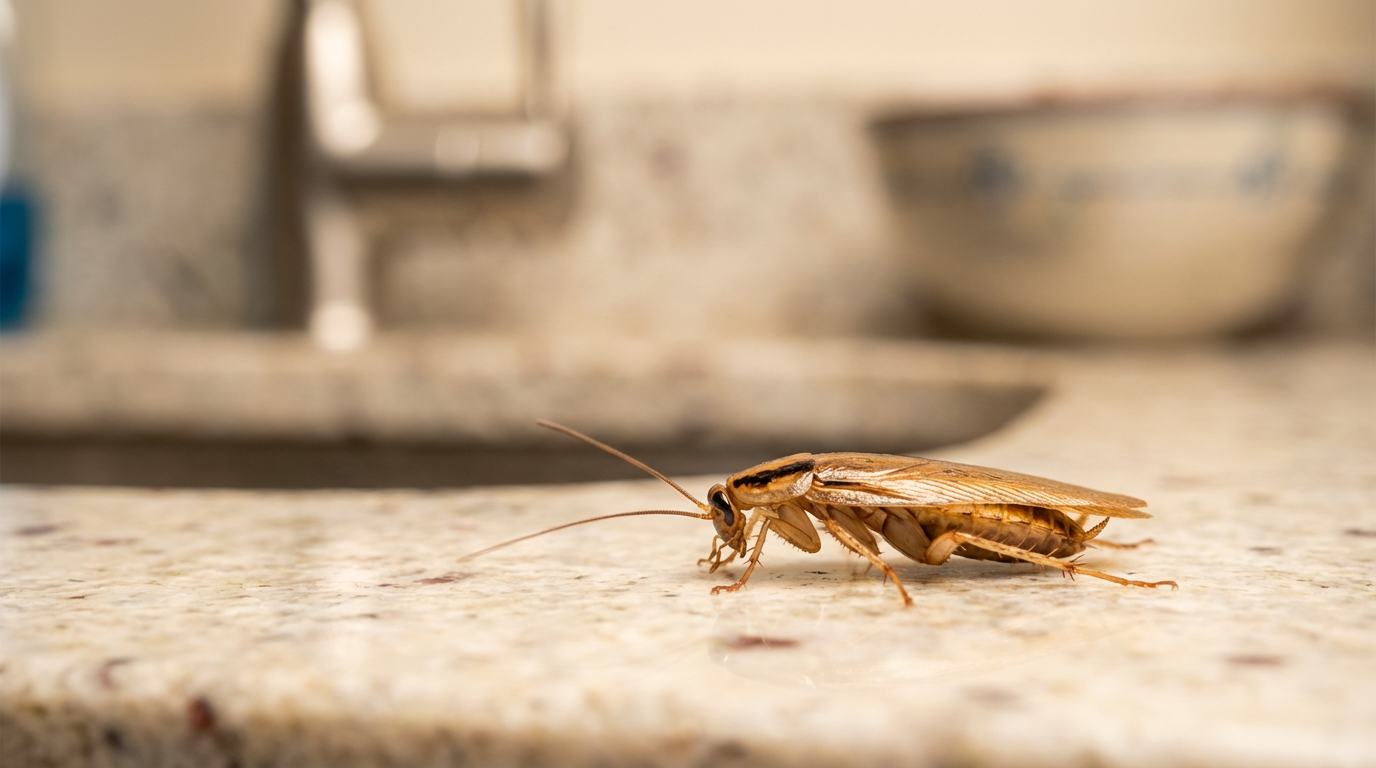
Adult German cockroaches are 13 to 16 millimeters long (roughly half an inch), tan to light brown, with two distinctive parallel dark stripes running from the back of the head down the pronotum. Both sexes have fully developed wings but rarely fly—they prefer to run, and they are remarkably fast, covering about 3 feet per second.
Adults live for approximately 100 to 200 days. Females can begin producing oothecae within a week of their final molt if they have mated. Males are slightly smaller and more slender, with a tapered abdomen, while females have a broader, rounder abdomen, especially when carrying an ootheca.
From One Roach to Thousands: The Math Behind an Infestation
Here is why German cockroach populations grow so alarmingly fast. Consider a single mated female:
- She produces her first ootheca within about 2 weeks of becoming an adult
- Each ootheca contains roughly 35 viable eggs
- She produces a new ootheca every 4 to 6 weeks
- Her offspring reach reproductive maturity in 60 to 100 days
- Approximately half of those offspring are female, each repeating the cycle
According to entomologists at NC State University, a single female and her descendants can theoretically produce over 300,000 individuals in one year under ideal conditions. Real-world numbers are lower due to mortality, but populations of several thousand per household are commonly documented in heavy infestations.
This reproductive speed is precisely why a "wait and see" approach never works with German cockroaches. Every day without treatment means exponentially more roaches breeding in your walls and cabinets.
Where Each Life Stage Hides
German cockroaches are thigmotactic—they prefer to squeeze their bodies into cracks and crevices where surfaces touch them on multiple sides. Different life stages tend to concentrate in specific areas:
- Oothecae and early nymphs: Deep inside wall voids, behind refrigerator compressor areas, under dishwasher insulation, inside electrical junction boxes
- Mid-stage nymphs: Cabinet door hinges, drawer slides, behind outlet and switch plates, microwave ventilation areas
- Late nymphs and adults: Under sinks near plumbing penetrations, behind stoves, in pantry shelving joints, along the upper edges of door frames in kitchens and bathrooms
Understanding these preferences helps both during inspection and when placing professional-grade gel baits and monitors. A treatment that targets only visible adults misses the majority of the population hiding in harborage areas.
Why Professional Treatment Targets Every Stage
Over-the-counter sprays may kill the adult roaches you see, but they do almost nothing to the eggs inside oothecae or the nymphs deep within wall voids. Worse, repellent sprays can scatter the colony into untreated areas, actually spreading the infestation throughout your home.
Professional German cockroach treatments at Romex Pest Control are designed to target all life stages simultaneously:
- Non-repellent gel baits are consumed by foraging adults and nymphs, who then transfer lethal doses to nestmates through contact and feces
- Insect growth regulators (IGRs) disrupt the molting process in nymphs and prevent oothecae from developing properly
- Crack-and-crevice applications reach deep harborage areas where eggs and nymphs concentrate
- Follow-up monitoring catches newly hatched nymphs from oothecae that were already deposited before initial treatment
This multi-stage approach is why professional treatment succeeds where DIY efforts typically fail. Contact Romex Pest Control for German cockroach treatment starting at $149 per treatment across our service areas in Texas, Oklahoma, Louisiana, and Mississippi.